What a Quảng Bình Place Name Can—and Cannot—Tell You
Learn how a Quảng Bình place name frames casino-style entertainment, so you can distinguish regional context from a statement about local leisure habits.

Does a headline about casino-style entertainment describe a leisure habit in Quảng Bình, or merely place the subject beside the province’s name? The wording can point to local activity, a visitor audience or a regional frame, and those meanings are not interchangeable.
A place name can say something about how a subject is being presented without telling you what people in the province do for leisure. That distinction matters especially when a headline compresses a broad topic into a few words.
Quảng Bình casino-style entertainment can be a frame, not a local habit
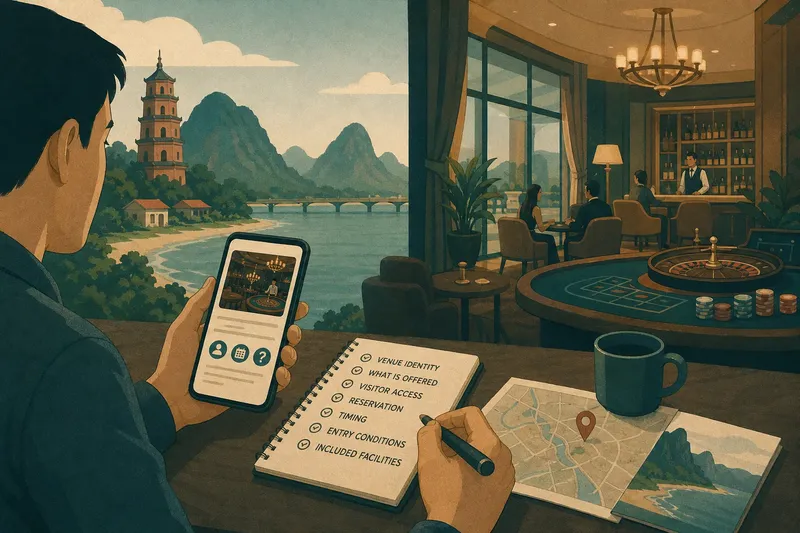
Look first at the relationship the sentence creates. “Residents enjoy casino-style games” makes a claim about people’s habits; “casino-style entertainment for visitors to Quảng Bình” identifies an audience; “casino-style entertainment in Quảng Bình” may simply be a topic label unless the surrounding sentence makes the location clear.
The grammatical subject helps. In “visitors consider casino-style entertainment while planning a trip”, visitors are considering an option. The sentence does not say that the activity is part of everyday leisure in Quảng Bình.
Even wording that sounds local needs a careful reading. A sentence about an event taking place in the province concerns a particular occasion, not necessarily a widespread custom or a regular leisure habit.
Read for people, occasions and time
To understand a claim about local leisure, ask who is doing what, where, and at what time. “Local residents play” describes a different group from “tourists may look for”; “a themed event was held” describes a particular occasion rather than a continuing pattern.
Time words narrow the meaning further. “Used to”, “hosted” and “during a festival” point to a past or bounded context. Present-tense language may sound broader, but the sentence still needs to say who participates and what activity it means.
For casino-style entertainment, distinguish games as a theme from gambling as an activity. A social games evening, a casino-inspired stage set and wagering are not the same thing; a headline may use a familiar label without clarifying which meaning it intends.
Keep the summary within what the wording supports
When describing a passage, preserve its scope. If it addresses visitors, say that it addresses visitors. If it mentions a single event, call it an event. Do not turn either one into a statement about what residents generally prefer.
This is also where a little restraint helps. It is not worth parsing every decorative adjective or trying to infer a community’s habits from a colourful theme; focus on the people named, the activity described and the time frame given.
A headline can be useful context without being a complete account of local culture. The difference between “a story discusses casino-style entertainment in a Quảng Bình visitor context” and “casino-style games are a local pastime” is substantive, not cosmetic.
Check what a sentence says about leisure habits
For a quick reading check, identify the group, activity and time frame in the actual wording. Then choose a description that does not extend beyond those details.
- Observation: The sentence names visitors as the audience but says nothing about residents. If you are describing its scope, then call it visitor-focused; otherwise, if you need a claim about residents’ habits, find wording that addresses residents directly.
- Observation: The passage describes one themed games evening. If it gives a specific occasion, then describe that occasion; otherwise, if the time or frequency is missing, avoid calling it a regular local activity.
- Observation: The wording says “casino-style” but does not explain whether it means themed games or wagering. If the activity is unclear, then retain the broad label; otherwise, if the passage defines it, use the more precise description.
- Observation: Residents appear in the text, but only as people being interviewed about travel. If they are not described participating, then do not present the passage as evidence of their leisure habits; otherwise, describe only the participation it explicitly states.
- Observation: A sentence says an event “was held” but gives no present-day context. If you are summarising its timing, then keep it in the past; otherwise, if current habits are the question, seek wording that addresses the present.
- Observation: A broad phrase links a leisure topic to Quảng Bình without naming who takes part. If no group is identified, then call it a regional framing; otherwise, if another sentence names participants, summarise that narrower claim instead.
A worked reading keeps a visitor frame separate from a local habit
Imagine a short passage headed “Casino-style entertainment for visitors to Quảng Bình”. Its body says that travellers may be curious about themed games, but names no residents, event or local custom. First, note that “for visitors” defines the intended audience. Next, check the body for a claim about residents and find none. The supported description is that the passage frames the subject for visitors; the trade-off is that you cannot use it to say whether casino-style games are a local leisure habit.
If you were writing a short account, “The passage discusses casino-style entertainment in a Quảng Bình visitor context” would preserve the evidence. “Residents in Quảng Bình enjoy casino-style games” would add a claim the passage does not make.
What do readers ask about Quảng Bình leisure wording?
Does “casino-style entertainment in Quảng Bình” describe a local habit?
Not by itself. The phrase may locate a topic or frame it for visitors, so look for explicit wording about who takes part and whether the passage describes a habit or a single occasion.
Does a visitor-focused sentence say what residents enjoy?
No. It identifies its audience, not the leisure preferences of residents. A separate statement about residents’ participation would be needed to make that claim.
Is a casino-themed games event the same as gambling?
Not necessarily. “Casino-style” can refer to a theme or style of games, while gambling involves wagering; use the more specific term only if the passage supports it.
How should an unclear statement about local leisure be described?
Report the frame the wording actually provides, such as a visitor context or a regional mention. Avoid turning that frame into a claim about residents’ regular habits.
A Quảng Bình place name can provide useful context, but it does not identify a community’s leisure habits on its own. When you repeat a claim, keep its group and time frame attached: a visitor interest, a one-off event and a local custom each say something different.