How “Resort” Shapes the Idea of a Quảng Bình Holiday
See how a resort shapes a Quảng Bình holiday, and plan time for its distinctive coast, town life and cave country without mistaking one venue for the province.

What do you expect when a holiday listing calls a place a resort? In Quảng Bình, the word can suggest a leisure setting with its own rhythm, but it says little by itself about how that stay relates to the province’s coast, town life and cave country.
That distinction is more than a question of where to sleep. It is about how a visitor imagines leisure: as something gathered within a venue, as time spent among local places, or as a meeting of the two.
The word resort sets expectations about leisure
In travel language, “resort” suggests that the accommodation is part of the holiday’s activity, rather than simply a place to return to at night. Visitors may picture dining, recreation or quiet spaces gathered around one property, though the word alone does not confirm which facilities are available.
That expectation matters in Quảng Bình, where a venue’s leisure offer sits alongside a region known for varied landscapes and local routines. A resort can shape a visitor’s experience without standing in for the province or explaining its culture.
Quảng Bình’s cultural texture comes from more than scenery
The province is often associated with the coast and the caves of Phong Nha-Kẻ Bàng, but a visit also takes place amid everyday settings: meals, markets, town streets and the practical movement between places. These are not interchangeable attractions; each gives a different sense of how a place is lived in and visited.
A resort-centred holiday may make the venue itself a social setting, where visitors share meals or leisure time. Time outside it can bring a different pace and a closer encounter with local businesses and public spaces. Neither mode is a complete portrait, but recognising the difference helps keep a leisure brand from becoming a claim about local identity.
Casino-style entertainment remains one part of a venue’s offer
Where casino-style entertainment is part of a venue’s identity, it belongs to a particular idea of leisure: organised activity within a managed setting. It does not define Quảng Bình’s wider cultural character, and its presence should not be assumed from the word “resort”. Visitors should check the specific venue’s current information rather than infer facilities from a label.
It is also useful to distinguish the activity from the place around it. A visitor may be drawn to a venue’s entertainment, yet still make room for a meal in town or an outing to a landscape that matters to the province’s public image. The point is not to rank those choices, but to understand what each can and cannot tell you.
How should you read the resort label in Quảng Bình?
Does resort mean the venue has casino-style entertainment?
No. The label alone does not establish that a venue offers casino-style activities or any particular facility. Check the venue’s own current description and local rules before making plans.
Does a resort stay offer a picture of local life?
It offers one setting within the province, often organised around visitor leisure. Town streets, markets and local businesses provide other encounters, though no single outing can represent everyone’s daily life.
How can a visitor make time for both venue leisure and local places?
Decide which parts of the stay matter most, then give each a clear place in the plan. For instance, keep one meal or outing outside the venue if meeting the town beyond the property is part of the purpose of the visit.
What is not worth the effort when interpreting the word resort?
Trying to find one universal definition is not useful. The better question is what the specific venue offers and what aspects of Quảng Bình you want your visit to include.
A worked plan connects venue leisure with local context
Imagine a visitor with a hypothetical three-day stay, one confirmed resort booking, one open afternoon, one evening available for a town meal and one planned outing to the Phong Nha area. They want to understand both the venue’s leisure offer and the wider setting, without treating either as a substitute for the other.
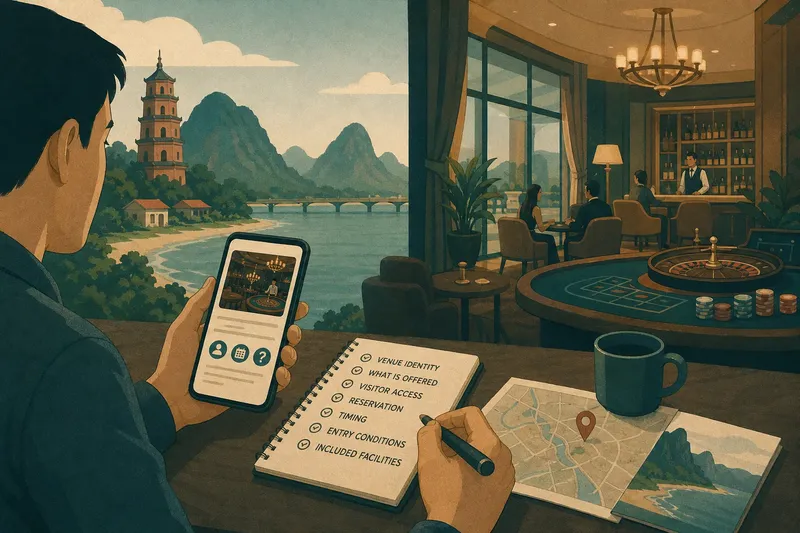
First, they check the booking details and the venue’s current information, writing down the confirmed facilities and marking casino-style entertainment as unavailable unless explicitly listed. The observable result is a short, reliable list of what the venue actually says it offers; if the activity is not listed, they leave it out of the plan rather than assume it exists.
Next, they keep the open afternoon at the venue and reserve the town evening for a meal outside it. They leave the Phong Nha outing as a separate part of the visit, so the plan includes a venue setting, a town setting and a landscape associated with the province. If travel arrangements make the outing impractical, they retain the town meal and use the open period for rest; the resulting plan still distinguishes the venue from local life rather than treating them as one experience.
A short planning check keeps the label in perspective
Before booking or setting an itinerary, check what the word “resort” means for the particular venue and decide what else you hope to encounter in Quảng Bình. Each observation should lead to a decision:
- Check whether the listing names specific leisure facilities; if it does, decide which ones matter to your stay, and if it does not, ask the venue or plan without assuming them.
- Check whether casino-style entertainment is explicitly described; if it is, consult the venue’s current terms and local rules, and if it is absent, do not infer that the resort label includes it.
- Check whether the booking information explains dining arrangements; if it does, decide which meals suit the venue, and if it does not, leave room to choose a meal elsewhere.
- Check whether town life is part of your purpose for visiting; if it is, reserve an outing for a local street, market or business, and if it is not, avoid adding travel simply to satisfy someone else’s idea of a complete holiday.
- Check whether a landscape outing such as the Phong Nha area is central to your interest; if it is, confirm transport and current access information, and if arrangements do not suit your plans, choose a different local activity or keep the time free.
- Check whether the itinerary has become crowded with competing activities; if it has, remove the least meaningful commitment, and if it has not, keep the mix as planned.
There is little value in debating whether every property deserves the same use of the word “resort”. The specific description, the visitor’s interests and the settings they make time for offer a clearer basis for understanding the stay.
A resort is one setting within Quảng Bình
Reading “resort” as a leisure label helps separate a venue’s offer from the province’s wider character. It can describe where some of a holiday’s activity is gathered, while leaving the meaning of town life, landscape and local encounters to the places and people beyond its walls.
For anyone considering a resort in Quảng Bình, the useful question is not whether the property can stand for the destination, but what role it should have in the visit. That distinction makes the word more informative—and leaves room for the province to be encountered on its own terms.